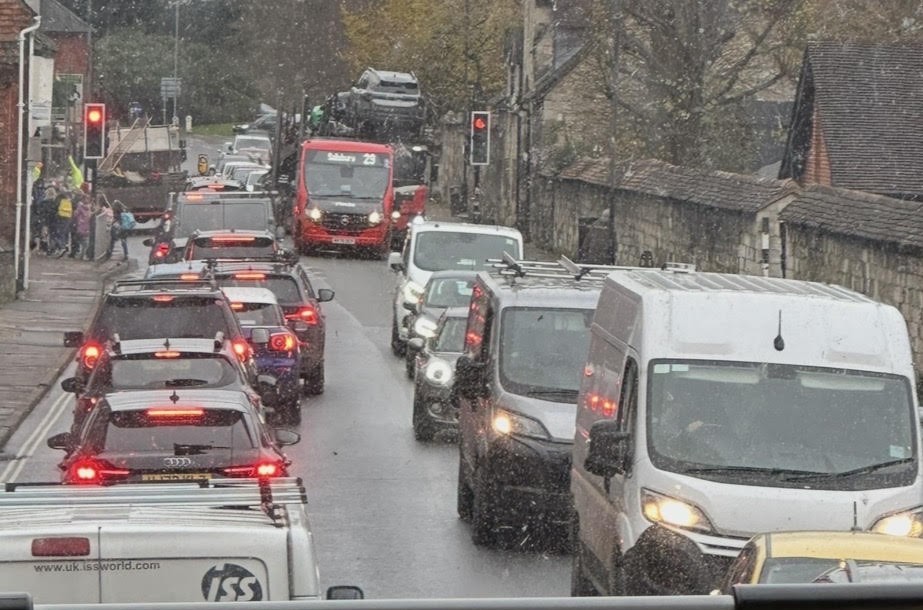
Will the 2026 Salisbury Transport Plan deliver a safe and vibrant city for active travel? Wiltshire Council is yet again in the process of preparing a “2026 Salisbury Transport Strategy” (last refreshed in 2018) to address issues including congestion, road safety, public transport, carbon emissions, and how people move around the city. Cllr Martin Smith, Cabinet Member for Highways, must show leadership to ensure the city’s transport network works for everyone, rather than reacting to negative comments on social media that result in the status quo of ”carma” geddon. 1
In recent years Salisbury experienced a number of downturns. This included the “Novichok” poisoning in 2018 and then the COVID-19 pandemic in 2019 that impacted visitor numbers and commercial income in and around the city. 2 3 As a result some residents are conservative and resistant to any changes taking place in the city that they percieive might have further negative impacts.
However, the evidence from other cities demonstrates that active travel and routing vehicles more efficiently results in cities that do work for everyone. On the contrary the high number of vehicles that dominate the streets in and around Salisbury has led to an increased risk and danger for all road users and particularly those walking, wheeling and cycling as well as negative impacts for buses users and local business.
Over the years, several strategies have aimed to reduce traffic in the city, but Salisbury remains gridlocked because of the high vehicle volumes. For example, In 1999, the Salisbury Transportation Plan Joint Committee took the decision to introduce the Salisbury City Centre 20mph speed limit zone. As part of the strategy the committee undertook a 30 month review of the road traffic injury accidents kept by the Police which reported:
- A halving of casualties within the Salisbury Relief Road
- 54 fewer people were injured in road accidents in central Salisbury, than expected based on the three-year record before the scheme.
- Injuries fell from an average of four people per month to two after the scheme was introduced.
- The Salisbury City Centre 20mph speed limit zone reduced casualties among all road users, with particularly benefits for pedestrians and cyclists.
There was no doubt that the introduction of 20mph speed limits resulted in a safer environment for all road users in Salisbury. However, traffic volumes continue to dominate the city and more recently two pedestrians have died after they were killed after being struck by vehicles (one in Fisherton Street, 20 mph and the other in Exeter Street – the only street within the ring road at 30mph). 4 5
More recently the Welsh Government introduced a 20mph default speed limit on local urban roads in 2023, and despite political opposition on social media, many have welcomed the benefits for local communities, including:
- 40% fewer collisions compared to 30mph areas
- 6–10 lives saved and
- 1,200–2,000 casualties prevented annually
- more people walking and cycling and a huge boost in active school travel from 49% to 74%.
- reduced insurance premiums for Welsh drivers due to the lower vehicle damage claims in 20mph areas
As 60% of the drivers passing through the Salisbury do not stop and contribute nothing to the city, Wiltshire Council attempted to introduce further measures in 2021, in a scheme known as “People Friendly Streets”. The Experimental Traffic Regulation Orders (ETROs) restricted some vehicular access into the city centre using ANPR cameras and used bus gates to allow buses priority into and out of the centre.
Early monitoring of the scheme demonstrated that it had not increased traffic on the A36 outside of the normal range and that traffic in the Low Traffic Zone reduced by around 50%, improving air quality in the centre. Average speeds in the city also decreased. However, the negative politicisation of measures to improve safety for those walking, wheeling and cycling as a “war on cars” resulted in the removal of “People Friendly Streets” shortly after its introduction. The ETRO was not allowed to run for the allocated time before being withdrawn.
People Friendly Streets was the first step in dramatically reducing city centre traffic and providing an environment that encouraged active travel. The refurbishment of Fisherton Street was intended to be the next stage to radically change city or walking and cycling and using the bus. However, after the People Friendly Streets was withdrawn, traffic in central Salisbury increased, and Fisherton Street (20mph), now carries more than 11,000 vehicle movements each day. 6
As 60% of the drivers passing through the city do not stop the free for all results in grid lock at peak times and on Saturdays. When the roads are gridlocked buses including, park and ride and those for further afield can easily take up to 20 minutes just to go from the market square to the ring road. In addition, the increased traffic numbers have reduced the experience (danger, noise and pollution levels) of those walking, wheeling and cycling.
One only has to visit Bath, where there has been a phased introduction of pedestrian and bus priority streets whilst restricting deliveries and other vehicle access at particular times to see the benefits that this has brought to the city. 7 Where there was the usual doom and gloom that the phased pedestrianisation would lead to deserted streets and empty shop, this has certainly not been the case. The Bath City Centre Active Travel plans has not only made the city centre safer for people walking and cycling but has significantly increased footfall and income for businesses. Increasingly, the Bath active travel strategy has made it easier for residents to get around without relying on a car and resulted in homes that offer walkable access to work, amenities and green space holding their value better than those reliant on car travel.
Increasingly Salisbury is actually falling behind progressive cities like Bath. Bath has introduced major phased pedestrianisation and active travel infrastructure resulting in high footfall and attractive shopping streets with affluent attractive shops. Meanwhile Salisbury streets are dominated by vehicles. The resultant congestion, noise and pollution increases the danger to pedestrians, cyclists and bus users and does little to attract a higher footfall and improved shopping experiences. It is clear that the forthcoming refreshed Salisbury Transportation Plan must provide major active travel solutions for residents and that Wiltshire council must engage with the community on the benefits of the overall schemes being proposed. Unless Wiltshire Council introduce radical solutions the city will continue to be grid locked for the foreseeable future.
Image copywrite: Jimmy Walker
Citations:
1. ‘I think it’s called Carma for those stuck in traffic’ | Salisbury Journal. https://www.salisburyjournal.co.uk/news/26475955.i-think-called-carma-stuck-traffic/.
2. A timeline of the Novichok poisonings in Salisbury | Salisbury Journal. https://www.salisburyjournal.co.uk/news/25672178.timeline-novichok-poisonings-salisbury/.
3. Epidemiology of COVID-19 in England: January 2020 to December 2024 – GOV.UK. https://www.gov.uk/government/publications/epidemiology-of-covid-19-in-england/epidemiology-of-covid-19-in-england-january-2020-to-december-2024.
4. Man charged following pedestrian’s death in Salisbury crash. https://www.bbc.com/news/articles/c9wxdk2kqpgo (2026).
5. Webb, D. J. Police reveal more about tragic fatal crash in Salisbury city centre. Wiltshire 999s https://www.wiltshire999s.co.uk/police-reveal-fatal-crash-salisbury-city/ (2025).
6. People Friendly Streets Salisbury is suspended indefinitely. Wiltshire Council https://www.wiltshire.gov.uk/salisbury-people-friendly-streets (2020).
7. Bath City Centre active travel plans | Bath and North East Somerset Council. https://www.bathnes.gov.uk/bath-city-centre-active-travel-plans.